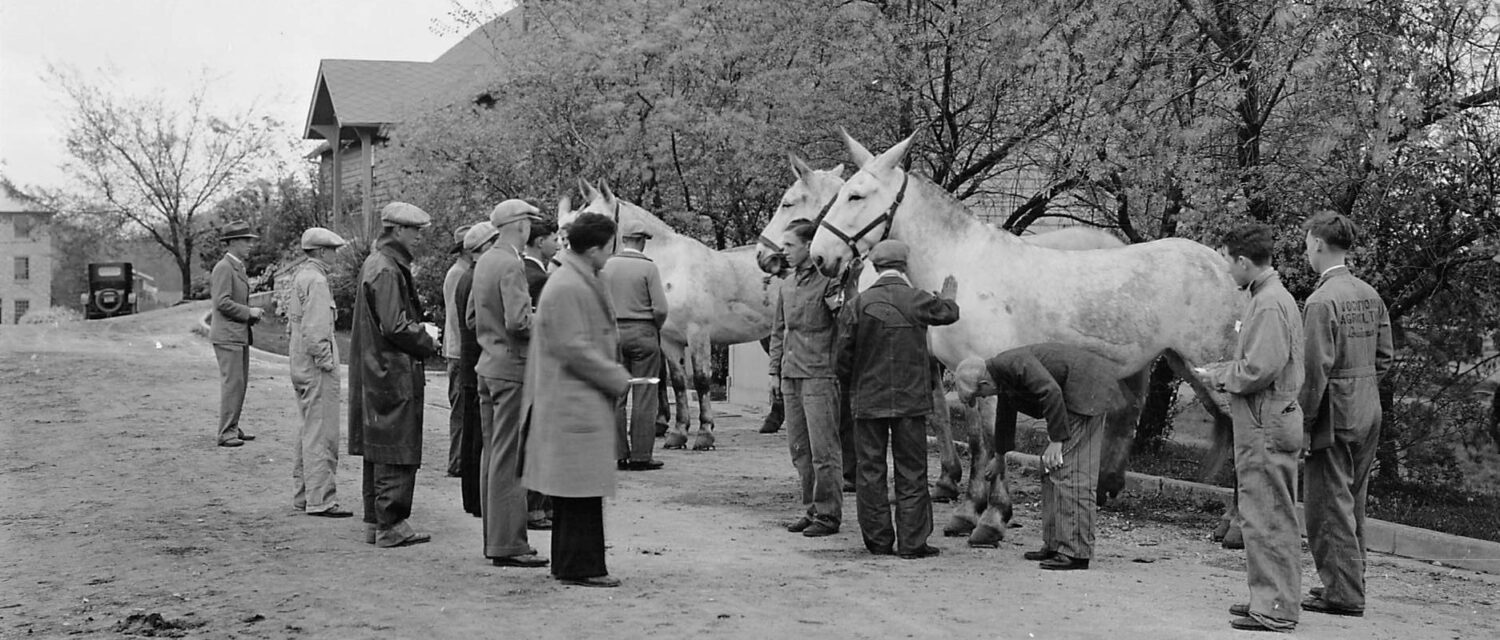
While reams of paper have been written about various aspects of the history of agricultural education one sees little in print about the veterans’ on-the-farm training program. All states, including Montana, operated training programs for World War II and Korean Conflict veterans in the 1940s and 1950s
This training was typically provided by agriculture teachers. In Montana the Veterans Administration contracted with the Montana State Department of Vocational Agricultural Education to provide the training.
In this Footnote we will learn more about the on-the-farm training program in Fromberg, Montana. Fromberg is located in Carbon County near the Wyoming border and is an agricultural town. In an article in the Montana Farmer-Stockman, Gill (1948, p. 1) states “…without agriculture it would, like hundreds of other towns in Montana, fold up like a broken cracker box.” The 1945 farm census found 979 farm families in the county. In 1950 the population of the town of Fromberg was 442 (the latest census lists 392 residents).
 Figure 1. Location of Carbon County in Montana. Figure from kiddle.co.
The Fromberg on-the-farm training program was somewhat typical of the other programs operating in Montana and across the country. In 1948 twenty-two schools in Montana were offering on-the-farm training and there were 253,000 veterans across the country in similar programs (Gill, 1945).
The Fromberg On-the-Farm Veterans Program
The agriculture teacher at Fromberg in 1948 was Jim Monforton (a navy veteran who had a degree in agricultural education from Montana State College). After getting approval to offer the program, he advertised the program to the veterans. Forty-six veterans enrolled in the program but many more wanted to enroll but the facilities and instructional staff could not handle more students.
The average age of the veterans at Fromberg was 24 years old. Sixteen percent had been officers while the remaining 84 percent were enlisted men. Sixty percent had been in the army, 32 percent were in the navy, and the remaining eight percent had been marines or in the coast guard (Gill, 1945).
Classes were conducted on Tuesday and Thursday evenings. The students were divided into two classes, one group met at the high school agricultural building and the second group met in a rented shop building. The students attending class in the shop building learned mechanical skills such as welding, repairing machinery, rebuilding engines, and using shop equipment. They were taught by a special hired instructor.
 Figure 2. A member of the on-the-farm veterans’ class at Fromberg, Montana. Photo from the Montana Farmer-Stockman, June 15, 1948.
The class taught in the agriculture building focused on livestock production, soils, crop production, and irrigation. There was an emphasis on local crops such as alfalfa, sugar beets, and orchard crops. Halfway through the program the students switched classes.
 Figure 3. The on-the-farm veterans’ class at Fromberg, Montana. Photo from the Montana Farmer-Stockman, June 15, 1948.
Field trips were taken from time to time to see the classroom lessons applied in real farming situations. At other times, the veterans and high school vo-ag students attended special educational events. In 1949 these two groups attended a livestock feeders forum sponsored by the Extension Service. See Figure 4.
 Figure 4. From the Fromberg News-Herald, December 8, 1949.
The on-the-farm training program required 200 hours of classroom and shop instruction. It also required 50 to 100 hours of supervised practice on the farm. For 77% of the Fromberg veterans, this practice occurred on the farms the veteran owned or leased. For the other 23 percent, they were placed on farms to learn skills from the farm owner/operator.
 Figure 5. The result of the on-the-farm veterans’ class at Fromberg, Montana.
Photo from the Montana Farmer-Stockman, June 15, 1948.
The Montana On-The-Farm Veterans Program
A 1947 article in the Chinook Opinion described the On-The-Farm program as it operated in Montana.

Figure 6. The Chinook (MT) Opinion, October 23, 1947
There was a concerted effort to inform veterans of the various government programs available to them. One method used was the “Vic Vet” cartoons. They ran in papers in Montana and across America.
 Figure 7. Left to right: The Chinook Opinion, September 18, 1947; Winnett Times, December 4, 1947; The Western News (Libby , MT), February 8, 1951; The Dillon Daily Tribune, July 7, 1948
Apparently, the cartoons served their purpose. In 1949 1,738 veterans were participating in the on-the-farm instructional program in Montana (Independent Record, Helena, MT, October 28, 1949). And at least one of them was a woman (See Figure 8).
 Figure 8. The Flathead Courier (Poison, MT), February 12, 1948
Curator’s Remarks
As we thank those who served in the military for their service, we should also thank the agriculture teachers who taught agricultural skills to the returning veterans. The on-the-farm training program was an important, but largely forgotten, part of the history of agricultural education. We need to remember the on-the-farm training program that started 80 years ago and honor those involved.
During my tenure on the faculty at Purdue University (1976-1982) I had the opportunity to supervise a student teacher who was teaching under Leon Crowe, the agriculture teacher at North Decatur High School. In addition to the day classes, Leon also taught a night class for Vietnam vets. After the Vietnam war the GI bill was extended to those veterans. Leon had his student teacher teach one of the evening sessions. It was interesting to say the least. The vets were grizzled war veterans who were older than the student teacher. I doubt if there are many university ag ed professors today who can say they observed a teacher who taught an on-the-farm training class for veterans.
For additional information about this topic please refer to the Friday Footnote titled “When Johnny Comes Marching Home” published July 12, 2019.
References
Gill, Larry (1948, June 15). GI farmers are getting another chance through on-the-farm training. Montana Farmer-Stockman.