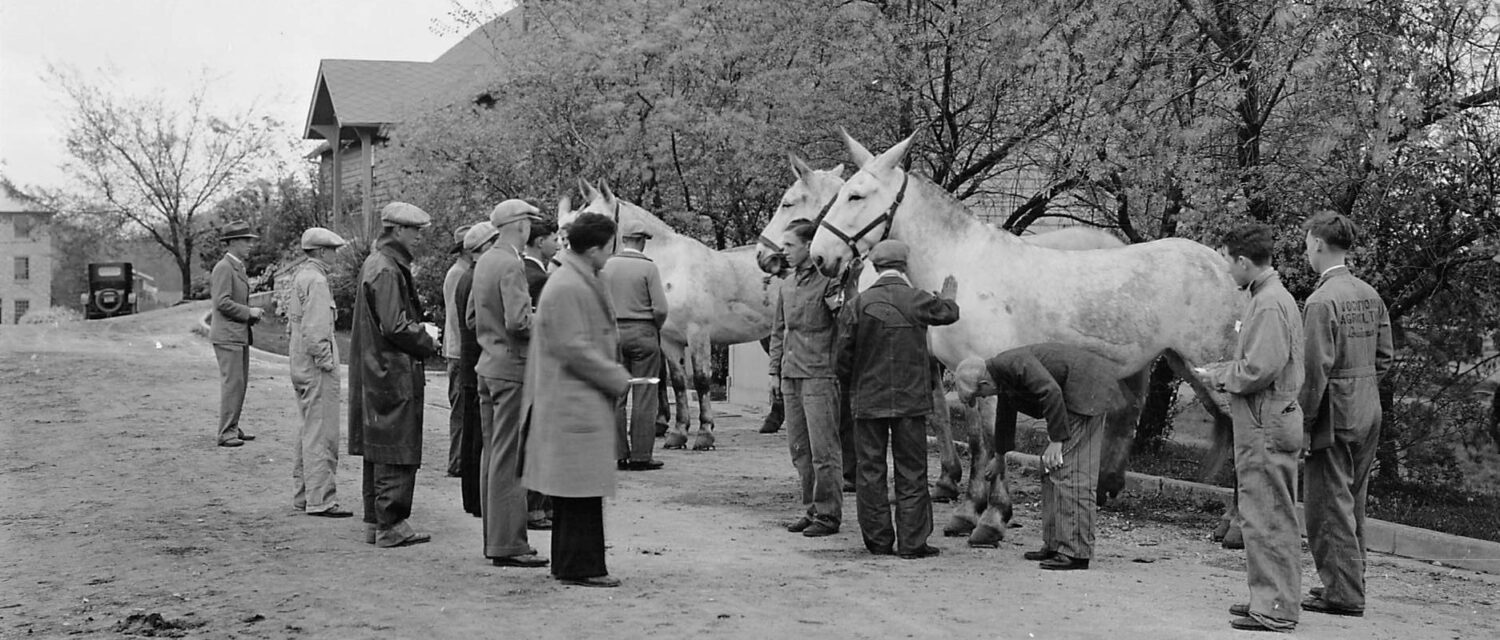
.jpg) Since August is American Artist Appreciation Month, we will take a break from our Footnote journey through the various states and spend some time looking at the art of agriculture. Dr. Jim Connors of South Dakota State University will curate our journal through agricultural art during the month of August. In September we will resume our agricultural education pilgrimage through the various states. Take it away Dr. Connors.
Since August is American Artist Appreciation Month, we will take a break from our Footnote journey through the various states and spend some time looking at the art of agriculture. Dr. Jim Connors of South Dakota State University will curate our journal through agricultural art during the month of August. In September we will resume our agricultural education pilgrimage through the various states. Take it away Dr. Connors.
Daniel Webster famously stated that, “When tillage begins, other arts follow. The farmers, therefore, are the founders of human civilization.” The “other arts” referred to in this quote could mean the art of growing crops, or the art of raising healthy livestock. Agriculture is commonly listed as both an art and a science. But another art could actually be artistic expression in the form of the painted picture.
This is the first in a multi-part series that will look at The Art of Agriculture. The series will include:
- The Art of Agriculture
- FFA Art
- 20thCentury Agriculture Art
- Agriculture & FFA Murals
- Agriculture Statuary/Sculpture
Agriculture as a subject of artwork goes back centuries. Cave paintings from Europe and Africa as far back as 8,000 to 3,000 B.C. depict cattle grazing. Egyptian tomb walls contain frescoes showing agriculture scenes from the Fertile Crescent region. Famous paintings of agriculture scenes from hundreds of years ago currently hang in some of the world’s greatest art museums. One example is the painting The Harvesters from 1565 which currently hangs in the Metropolitan Museum of Art (MOMA) in New York City. The painting shows peasants harvesting wheat.
 Figure 1: The Harvesters (Pieter Bruegel, 1565) Metropolitan Museum of Art, New York
Exposure to agriculture art was, and is, important for all students studying agriculture. In 1978, The National Future Farmer magazine included an article titled Five Great Farm Paintings (West, 1978). The paintings listed in the article included:
- Inside the Stable (1791)
- The Horse Fair (1853)
- The Angelus (1859)
- The Sheepfold (1870)
- Song of the Lark (1885)
These are all beautiful and well-known paintings of agricultural scenes. Probably the most famous of these is The Angelus (Millet, 1859). The article describes the painting in the following passage:
“The Angelus” (1859) shows a peasant and his wife. It is sunset and the blues and purples of evening steal across the sky and the horizon. The little village church is silhouetted against this vivid coloring. The couple is shown with bowed head as the prayer of the angelus (angels) is said. Their tools are laid aside; work is done. You see the Christian beliefs, the hard work, plain looks and clothes, beautiful country scenery and the honesty and contentment of peasant life.
 Figure 2:The Angelus (Jean Francois Millet, 1859) Musee d’Orsay, Paris.
The oldest painting described in The Future Farmer article is titled, Inside the Stable from 1791. The painting is by George Morland of England, who is “considered by most art critics as the greatest painter of farm scenes” (p. 28). It shows a farmer leading two horses and a pony into a barn. Morland painted many rural English scenes that included farm animals.
 Figure 3: Inside of a Stable (George Morland, 1791), Tate Britain
Another 19th century painting that depicts the hardships of farming is Anguish by August Friedrich Schenck in 1878. The painting:
depicts a distraught ewe bleating in grief, her breath freezing in the cold air. The mother sheep is standing over the dead body of her lamb, a trickle of blood running from its mouth into the white snow, in a scene reminiscent of a pietà. The pair of sheep are encircled by a murder of black crows that crowd ominously around under a dull grey cloudy winter sky, waiting for the opportunity to scavenge the carcass. (Wikipedia)
 Figure 4: Anguish (August Friedrich Schenck, 1878), National Gallery of Victoria, Melbourne
These are just four examples of pre-20th century agriculture artwork that can be found in any modern art museum or by surfing the internet. When these scenes were painted most of the world was still agrarian and a large majority of people still lived and worked on rural farms. These scenes, from America, Britain, France, and Australia show the harsh conditions that farmers faced every single day.
The opening line of the National FFA Creed states “I Believe in the future of agriculture, with a faith born not of words but of deeds…” These paintings depict the faith that farmers in the 1700s and 1800s had in the future of agriculture. They worked hard, prayed for favorable conditions, and anguished when animals died, or crops failed. It is the same today in 2025.
Suggested Activities
The following are some suggested activities to incorporate artistic expression into agricultural education programs.
- Browse the internet, art museum webpages, etc. to find a piece of agriculture artwork that speaks to you, one that you are interested in researching, or find touching and beautiful. Research the artist, place of origin of the painting, and subject of the painting. Find a downloadable copy and print it off to display in your agriculture classroom, home, barn, etc.
- Invite the school art teacher to give a presentation to agriculture students about the importance of art appreciation and how everyone, even agriculture students and FFA members can get involved in creating scenes of agriculture art.
- Invite the high school, community college, or university art instructor to your chapter to teach a session on creating agriculture art. Have FFA members who are interested paint agriculture art scene to be entered into the local county fair.
- Conduct an agriculture art exhibition for your school and community. Find as many pieces of agricultural art as possible to display in your school, agriculture classroom, school or community library. Draft descriptions of the artwork to be displayed along with the painting.
- Plan a field trip to a local art museum to meet with the curator and discuss agriculture art.
- Invite a professional photographer to your agriculture program to teach photographic art and how to photograph agricultural scenes for display or entry into the country fair.
References
Anguish (painting). (2024, December 9). In Wikipedia. https://en.wikipedia.org/wiki/Anguish_(Schenck)
Bruegel, P. (1565). The Harvesters [Painting]. Metropolitan Museum of Art, New York, New York, United States of America.
Millet, J. F. (1859). The Angelus [Painting]. Musee d’Orsay, Paris, France.
Morland, G. (1791). Inside of a Stable [Painting]. Tate, London, England. https://www.tate.org.uk/art/artworks/morland-inside-of-a-stable-n01030
Schenck, A. F. (1878). Anguish [Painting]. National Gallery of Victoria, Melbourne, Australia
The Angelus (painting) (2024, November 3). In Wikipedia. https://en.wikipedia.org/wiki/The_Angelus_(painting)
The Harvesters (painting) (2024, December 24). In Wikipedia. https://en.wikipedia.org/wiki/The_Harvesters_%28painting%29
The Artistry of Jacques Pepin (n.d.). Farming in Art History. https://jacquespepinart.com/art/farming-in-art-history
West, G. (1978). Five great farm paintings. The Future Farmer Magazine, 26(5), 28.