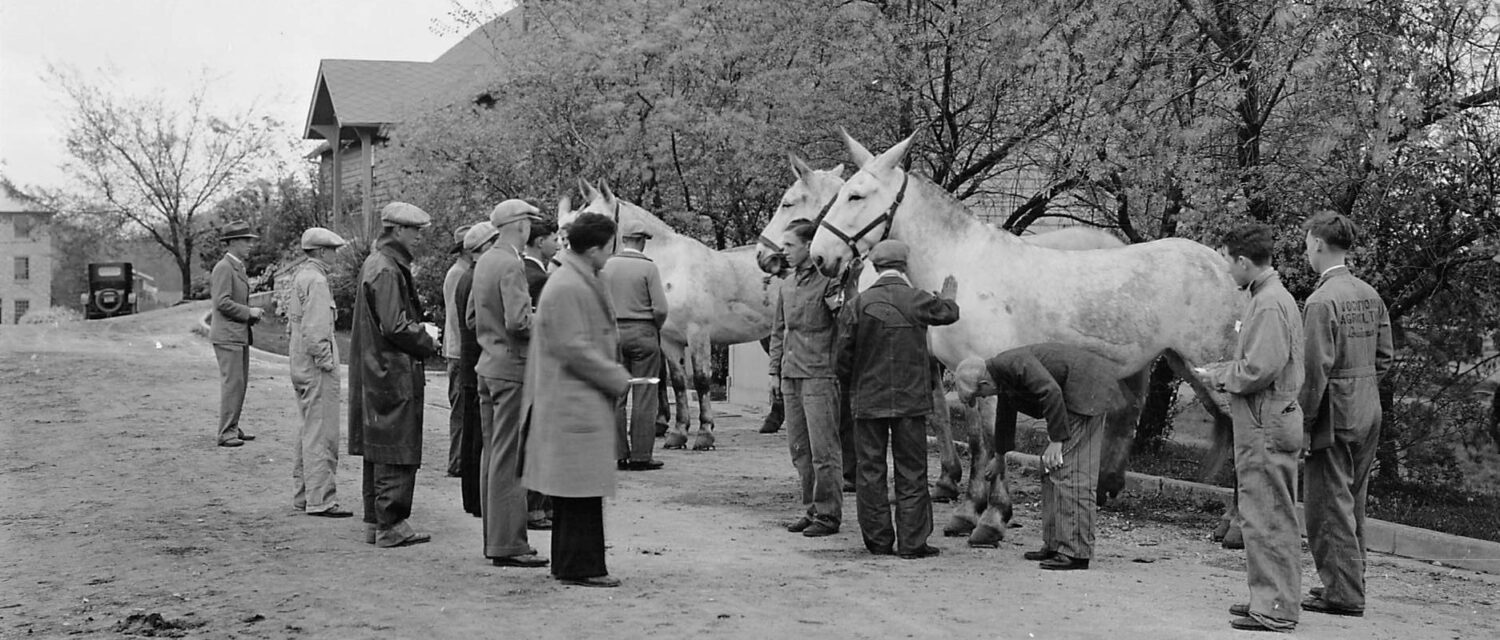
How would you like to teach agriculture in a state where the agriculture teacher was given a home to live in rent-free? If you were to teach in Mississippi in 1914 that would be the case. The State Director of Vocational Education, in a letter dated April 14, 1914 wrote (Stimson and Lathrop, 1942, p. 253):
Each white school shall have a minimum of one teacher’s home, worth not less than $1,500 owned by the school, located on the school land, and available for use by the vocational agriculture teacher, free of rent. Large schools should own at least two teacher’s homes. Negro schools will be encouraged but not required to provide a teacher’s home rent-free, for the teacher of vocational agriculture.
The above paragraph was part of the Mississippi state plan for vocational agriculture in 1914.
In case you have not realized it yet, we are continuing our Friday Footnote visits to various states to learn more about agricultural and extension education. This week we start our journey through Mississippi and will focus on agricultural education in Mississippi for the next several weeks.
The Beginnings of Agricultural Education in Mississippi
In the early 1900s legislation was passed in Mississippi authorizing the consolidation of rural schools. Along with this movement the state superintendent of public education, J. N. Powers in his 1907 report, recommended that agricultural high schools should be established across the state.
Part of the rationale for this recommendation was that the State Department of Agriculture had established “Mississippi Farmer Boys Experiment Clubs” in cooperation with county school superintendents. The clubs in conjunction with the agricultural high schools would be able (Stimson and Lathrop, 1942, p. 252) “to disseminate the most improved methods of agriculture throughout the state.”
In 1908 a Mississippi law was passed to permit counties to establish agricultural high schools for which a tax not to exceed 2 mills could be used to support the schools. After the schools were established, the state would give it $1,000. Within a year 15 counties had established agricultural high schools.
The Teacherage
Now let’s return to the rent free home for agriculture teachers discussion. Mississippi is decidedly a rural state. This was true in the early 1900s and is still true today ranking 4th behind Vermont, Maine and West Virginia in rural population. Housing for teachers is hard to find in remote rural areas. Maxcy (1978, p. 267) stated:
Finding adequate housing was one of the most pressing problems teachers faced in rural America in the 1890s. Typically, school teachers had to “board around.”’ Teachers would be given a room and sometimes their board in the home of parents of school children, on a rotating basis. Neither teachers nor parents were enthusiastic about the arrangement. Teachers complained of poor meals, inadequate sleeping quarters, lack of a place to study, and no room for guests. Rural parents disliked the practice because it placed a burden on the family larder and posed a threat to privacy.
To address this problem, especially for the newly created county agricultural high schools in Mississippi, the 1914 plan for vocational education contained the provision to have a rent-free home for the agriculture teacher. This would help but how about teachers other than the agriculture teacher employed in the county agricultural high school? They would also need a place to live. The answer to this dilemma is the teacherage. So what exactly is a teacherage? According to Google:
A teacherage is a residence, typically located near a school, that provides housing for teachers. It’s often found in rural or remote areas where finding suitable housing for educators can be challenging. Teacherages can be single-family homes or apartments, and they sometimes include shared living spaces like dining areas or parlors.
There were basically two styles of teacherages. One style was small individual houses designed for teachers with a family. Another style was a large building with multiple apartments. Typically single teachers would live in the apartment style of teacherage.
 Figure 1. L. A multi-unit teacherage at Ashland High School in Benton County Mississippi. The vocational building is to the left of the teacherage. R. A teacher’s home at Ashland High School in Benton County (MS). This home was supplied by the school.
In 1916, the National Lumber Manufacturers’ Association proposed building a home for every rural school teacher in America. The Newton (MS) Record (June 15, 1916, p. 3) stated “Mississippi will be one of the first states where the plan will be carried into effect.” The Rockefeller Foundation has (p.3) “…approved of the plan and is giving $25,000 to foster this work with more money to come.” The idea was that the construction of teacherages would help solve the problem that “The country school are always left with the largest proportion of young, inexperienced, poorly trained teachers.” Apparently, this idea was never implemented, possibly because of the outbreak of World War I.
In a presentation to a federation of women’s clubs in Gulfport, Mississippi in 1915 one of the speakers spoke about teacherages in glowing terms (See Figure 2)
 Figure 2. From the Sun Herald of Biloxi, Mississippi, March 23, 1915.
In 1922 the U.S. Government sent a questionnaire to 2,874 county superintendents. It was found that there were approximately 3,000 teacherages in the United States. Of this number, 2,400 teacherages were owned outright by the schools, 57 buildings were donated, 170 teachers’ homes were rented, and 189 schools contained living quarters for teachers. (Muerman, 1922). Teacherages were more commonly found in the southern and western states. Three-fourths of all the teacherages in the United States were found in Texas, Oklahoma, California, Colorado, Mississippi, Washington, Idaho, North Dakota, Louisiana and Montana.
The agriculture teachers living in the teacherages in Mississippi took pride in their homes. C. E. Ross, the agriculture teacher for the Neshoba Consolidate School district, was able to convince a farmer to landscape his home properly. The farmer was impressed with the job Mr. Ross had done in landscaping the teacherage where he lived. See Figure 3.
 Figure 3. The Clarion-Ledger (Jackson, MS), March 19, 1930.
Of course the agriculture teacher should serve as a role model for the community. Perhaps that is why the vocational agriculture students at one school built a sanitary privy at the school’s teacherage. See Figure 4.
 Figure 4. The Clarion-Ledger (Jackson, MS), March 26, 1930
In Oklahoma I don’t know if the agriculture teacher really wanted to live in the teacherage at the Post Consolidated school. In 1924 the four room teacherage was completed and two families were to live in it – the school superintendent and family and the agriculture teacher and his wife. How would you like to live with the school superintendent? See Figure 5. The newspaper article identifies the vocational agriculture teacher as the “Cocational” teacher. Since he was co-habiting the teacherage perhaps Cocational is correct.
 Figure 5. The Sentinel (OK) Leader, August 28, 1924.
Concluding Remarks
Teacherages live! Recently, a person in Louisiana bought a house to renovate and then discovered it was originally a teacherage with five bedrooms on the second floor for teachers. You might enjoy the 51 second video at https://www.tiktok.com/@simplysoutherncottage/video/7355215173688298795
A former teacherage built in 1925 in Wake County, NC has been converted to office space for lease. The name of the office building is “The Teacherage.” In describing the history of the building it is stated:
In the 1940’s, 50’s and 60’s, the building served as a boarding house for young teachers who taught at the Fuquay Springs School (grades 1-12) just across the street. Here they devised their lesson plans, graded student papers, talked about issues of the day, and ate, slept and socialized under one roof year round. Several young teachers met their spouses here and married. Today, the wide hallways are lined with vintage pictures depicting these former educators from a bygone era, along with several testimonials about their life and times here.
 Figure 6. “The Teacherage” in Fuquay-Varina, NC.
On Mayne Island, off the coast of British Columbia, a group of parents are restoring a teacherage in hopes of attracting and retaining a teacher for the 29 K-7 students at the Mayne Island School. It has been challenging to find a teacher because of the remoteness of the island.
In Arizona several school districts have started building teacherages at part of a pilot program to attract and retain teachers.
While we like to think of the teacherage program for agricultural teachers in Mississippi in 1914 as being a historical artifact, the idea still has merit today; especially as we continue to face teacher shortages. Perhaps we need to go back to the future.
References
Maxcy, Spencer, J. (1979). The Teacherage in American Rural Education. The Journal of General Education, Vol. 30, No. 4 (WINTER 1979), pp. 267-274. https://www.jstor.org/stable/27796717
Muerman, J. C. (1922), The District Owned or Controlled Teachers’ Home, Bulletin No. 16, Washington, D. C: Department of the Interior, Bureau of Education.
Stimson, R. & Lathrop, F. (1942). History of Agricultural Education of Less Than College Grade in the United States. Vocational Division Bulletin No. 217. Federal Security Agency. U. S. Government Printing Office.