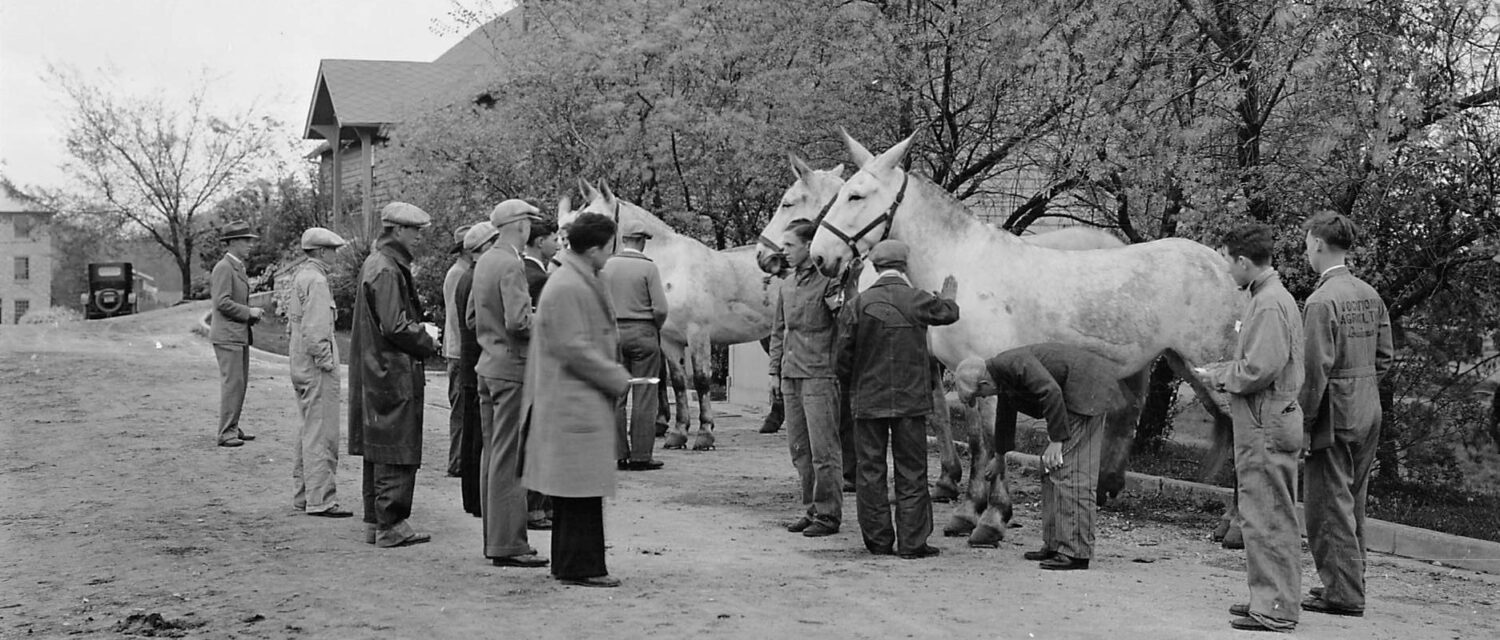
This week we continue our journey through MIssissippi.
The three guest columnists for this Footnote are Gaea Hock, Mary Helen Lett, and Gayle Crowder Clark.
They will be introduced later.
My husband and I (Gaea) love to go to estate sales and auctions. You never know what treasures will be uncovered! Shortly after moving to Mississippi to begin my tenure at Mississippi State University as an assistant professor of agricultural education we attended an auction in Starkville, MS. It was a cold day in December so there weren’t many people in attendance. The auction was getting close to being finished when, out of the corner of my eye, I spotted a framed diploma. I kept my excitement well-hidden as several items prior to the diploma were sold. Finally, I won the bid and paid $6 for a diploma from Bolivar County Agricultural High School belonging to Lela Bell Dean dated May 21, 1918 (Figure 1).
 Figure 1. Bolivar County Agricultural High School diploma dated May 21, 1918 purchased by Dr. Hock at an auction for $6.
While this document may seem insignificant to some, I wanted to own a piece of Mississippi agricultural education history. Little did I know that this small antiquity would reveal to me the influence vocational agriculture had on the development of Mississippi’s education system.
Before Smith-Hughes
The Smith-Hughes Act of 1917 is an important piece of our agricultural education history, but Mississippi began work to educate their rural youth in the early 1900s. Challenges facing the rural parts of the state such as poor roads, few automobiles, and insufficient schools led to the development of agricultural high schools.
In 1908 the Mississippi Legislature passed laws that permitted counties to establish agricultural high schools in order to provide better educational opportunities for the state’s rural students. The legislation was written to allow county school boards to establish boarding agricultural high schools, offering agriculture for boys and home economics for girls, as well as a full academic curriculum. While the original law only included schools for white students, the law was revised in 1910 to include African American children as well.
Bolivar County Agricultural High School and Forrest County Agricultural High School were among the first agriculture boarding schools to open in 1911, and by 1921, 51 agricultural high schools were in operation. This was a great accomplishment in a state that has only 82 counties. Coahoma Agricultural High School, the first of such schools for African-Americans, opened in 1924.
 Figure 2. From the Hattiesburg (MS) Daily News. August 10, 1912
The schools were unique in that they had dormitories on campus. This allowed the children to remain on campus during the week. They did not charge tuition but did charge a small fee for room and board ($10 per month in 1918 at Hinds County Agricultural High School). Students could earn money to pay their boarding fee by working on the school farm or other locations on the campus.
Transition Time
The golden era for agricultural high schools in Mississippi did not last long. By the early 1920s, the total number of public schools in Mississippi exceeded 750. The state legislature began to consolidate schools as early as 1916 and by the 1920s many agricultural high schools were no longer open. However, the Smith-Hughes Act of 1917 allowed many of the consolidated high schools to continue offering vocational agriculture courses.
Through modernization of the automobile, students were able to be transported longer distances and the options for rural students increased. This led to no additional white-only agricultural high schools after 1919, two programs closing before 1923, and many schools closing their on-campus living facilities.
To avoid closure or consolidation, leaders of some of the agricultural high schools developed a solution. These schools would begin to offer one or two years of college courses to their students, while still providing affordable access to a quality education for rural students. Hinds County Agricultural High School and Pearl River County Agricultural High School were the first to start offering both high school and college classes to their students as early as 1921. These programs were able to maintain their enrollment while offering college classes to a population that would not normally have access to higher education. This led to the agricultural high schools in the state helping establish a robust community college system in Mississippi.
In 1922, the Mississippi Legislature enacted a law that allowed qualified agricultural high schools to extend their curricula and offer college courses. The agricultural high school had to meet certain criteria including a geographic distance from the existing senior colleges in the state (one of which was Mississippi State University), highly-qualified teachers, and admission criteria for students.
While the number of agricultural high schools decreased, the new junior colleges in the state rose to meet the challenge of providing “quality, accessible, and inexpensive education for the state’s students” (Fatherree, 2010, para 10). These community colleges continue to educate youth and adults in the rural parts of the state.
By 1928, “ten Mississippi agricultural high schools were offering at least one year of college courses and two more were scheduled to do so in the fall of that year” (Fatherree, 2010, para 11). In an effort to limit the number of junior colleges in Mississippi, the state was divided into 13 districts in 1928 with only one junior college in each. The work done in Mississippi led it to be the first state system of junior colleges in the U.S. Today, there are 15 community colleges in Mississippi, 14 of which began as an agricultural high school.
The Last of Its Kind
Currently, Mississippi has 148 school districts and 117 high school agriculture programs. Only one of the original agricultural high schools remains active today. Open for 114 years, Forrest County Agricultural High School, in Brooklyn, still works to meet its original mission (Figure 3).
 Figure 3. Forrest County Agricultural High School was one of the first agricultural high schools in the state of Mississippi. It is the last remaining school of its kind.
Forrest County Agricultural High School (FCAHS) was established in 1911 when four local families each set aside eighty acres to provide the land for the school (Figure 4). Community members saw a need for students to learn hands-on skills and trades in addition to the traditional academic opportunities. That tradition continues to this day as FCAHS proves to be one of the most diverse and successful districts in the state. FCAHS was recently rated an A district and was named the third highest-ranking school district in Mississippi (Forrest County AHS, n.d.).
 Figure 4. Forrest County Agricultural High School began in 1911 when four families each donated 80-acres to establish the 320-acre campus.
Students from all walks of life have roamed the campus over the past century. While FCAHS no longer operates as a boarding school, this option was allowed until 1989 (See Figure 5). Students from all across the state, as well as hundreds of international students, have graduated from FCAHS. Each spring, hundreds of alumni return to campus for the annual homecoming celebration, where old classmates and roommates reminisce about their time at FCAHS. Many of these alumni will tell stories of working in the school’s dairy barn, as the boys were in charge of the farm while the girls learned about homemaking. Many could tell you about practical jokes played in the school dormitories, of which students often worked to pay for their room and board. While much has changed over the past century, one thing still remains the same — students are receiving a quality education with opportunities for real-life experiences and hands-on learning.
 Figure 5. The boy’s dormitory building at Forrest County Agricultural High School stopped housing students in 1989.
It was torn down a few years ago in order to have a new storm shelter built.
As the only remaining independent agricultural high school with an active FFA chapter in Mississippi, students ‘learn to do’ in a variety of ways at FCAHS. The school’s 320-acre campus boasts an extensive livestock program consisting of a commercial cow-calf herd, meat goats, hair sheep, horses, and hogs. Many of the students use school-raised animals to compete in local and regional livestock shows. The horticulture program has two greenhouses, a high tunnel house, and has recently transplanted more than one hundred blueberry bushes. About 600 students attend FCAHS and each year 160-170 of them take an agriculture class in one of the three agriculture tracks (Introduction to Agriscience, Horticulture, and Agriculture & Natural Resources) all of which offer science credits.
Students are involved in every aspect of the day-to-day operation of the farm and play a large role in its success. Whether it is vaccinating animals, building fence, planting gardens, or cutting hay, students get a clear understanding of what a typical producer might go through on a daily basis. Students even help palpate cows and manage the greenhouse when it is time for the annual plant sale. These unique resources allow the three agriculture teachers at FCAHS to share the ultimate learning experience that encompasses hands-on instruction and the intent of the Smith-Hughes Act (Figure 6).
 Figure 6. FCAHS has a working farm as a component of the agriculture program that includes cattle, goats, sheep, hogs, and horses.
It doesn’t take long for a newcomer to realize that Forrest County Agricultural High School is a special place. Students and staff alike take pride in the school and hold tightly to the traditions that have served as the foundation of excellence. Even though the school was founded before the Smith-Hughes Act, this legislation played a large role in its success, as well as affording youth across the nation these same unique opportunities for experiential learning and career success.
Leaving a Legacy
The Smith-Hughes Act is an important piece of legislation in agricultural education history. In some states it helped create secondary vocational education, while in others it provided additional funding to support existing efforts. As our profession reflects over the past 100 years, we have the opportunity to appreciate how far we have come and where the next century will take us. Mississippi agricultural education has adjusted and is still working to provide the training and education to future agriculturalists.
While I never met Lela Bell Dean and Bolivar County Agricultural High School has long since closed, I am proud to own a piece of agricultural education history and often look at the diploma in my office as a sign of where we have been and how far we have come. It is important we take time to reflect on our accomplishments as we prepare for the next century of agricultural education.
References
Forrest County AHS. (n.d.) Home page. Retrieved from: http://www.forrestcountyahs.com/home
Fatherree, B.H. (2010, March). The community and junior college system in Mississippi. Mississippi History Now. Retrieved from http://www.mshistorynow.mdah.ms.gov/articles/333/the-community-and-junior-college-system-in-mississippi
Note: This article was originally published in the January/February 2017 Agricultural Education Magazine (Volume 89, Issue 4).
Update from August 2025
The FCAHS Agriculture Department is transitioning into a new program structure, utilizing the Diversified Agriculture curricula and offering courses that are more content-specific to better suit student interests. Students still utilize the 320-acre campus for all aspects of experiential learning. The school farm is home to horses, chickens, a commercial cow-calf operation, goats, a growing hair sheep herd and more. The program’s livestock show team continues to grow as students utilize school farm born and raised animals for their stock show projects, which can now be housed in a brand-new show barn. Community interest and support continue to drive the program; multiple donated satellite hay fields and a new hay barn helped to strengthen the ever-growing livestock programs. Students are busy beyond the farm gate, also. At this year’s State FFA Convention, the Brooklyn FFA Chapter had one member elected to a state officer position, one State Proficiency award winner, two state-winning teams, and thirteen State FFA Degree recipients. While we always work to honor our history and tradition of excellence, we embrace the opportunity to continue cultivating the leaders and achievers of the future.
Authors
Dr. Gaea Hock is now a professor of agricultural education at Kansas State University. She was at Mississippi State University from 2012-2016.
Mary Helen Lett is an agriculture teacher and FFA advisor at Forrest County Agricultural High School in Brooklyn, Mississippi. She serves as the school farm manager and is in her twelfth year as an instructor at FCAHS.
Dr. Gayle Crowder Clark is a former agriculture teacher. She has retired from public service where she was the former Mississippi FFA Executive Secretary, former secondary agriculture curriculum project manager at Mississippi State University, and she retired from the Mississippi Department of Agriculture and Commerce as an Agriculture Workforce Development Coordinator. She is currently serving in the private sector as the Academic Counselor and Dean of Students at Hillcrest Christian School in Jackson, Mississippi.