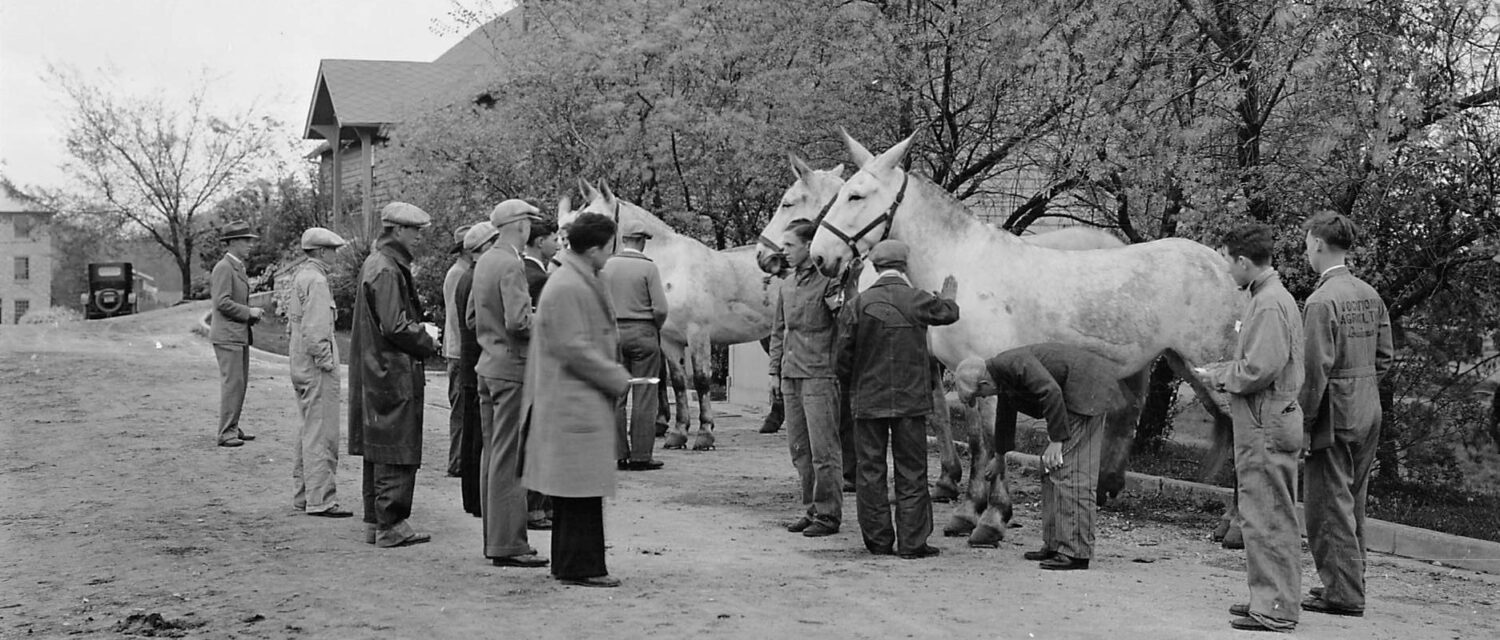
Some of the more seasoned agricultural educators might remember a FFA sponsored activity in cooperation with the R. J. Reynolds company known as BOAC – Building Our American Communities. This program was started in 1971. FFA chapters across America were engaged in various activities to improve their communities. As a high school agriculture teacher I was the advisor to an FFA chapter that received a BOAC grant to develop a community environmental center. However, BOAC was not really a new program. Just ask the folks in Missouri.
Would it surprise you to learn there was a “Community Improvement Contest” as early as 1926 in Missouri for Vocational Agriculture students and departments. And would it further surprise you to learn that there is an active BOAC grant program operating today in Missouri for the 4-H and FFA.
The Roaring 20’s and the Rising 20’s
The “Roaring Twenties” was a decade of dramatic social, economic, and cultural change, primarily in the urban areas. Out in rural America we might label the 1920s as the “Rising Twenties.” Missouri vocational agriculture students were actively engaged in the “raising up” of the rural areas through a “Community Improvement Contest.”
The Community Improvement Contest started with the 1926-27 school year. The contest was fostered by the State Department of Education. According to the Monroe (MO) City News (September 30, 1927, p.1):
The purpose of the contest is to create interest in improving the community by encouraging the use of better stock, better care of stock, better soil management, better crops, and better social life among members of the class and the people of the community. Points are also awarded for participation in certain school or church activities and for attendance at church each Sunday. All details have been worked out by the state department of education and the contest will continue until April, 1928.
Vocational agriculture students could earn points for performing selected activities related to their farming program and for participation in community activities. The State Department of Education identified 180 activities students could perform to earn points in the contest. Some of the activities were:
- For each purebred gilt purchased – 25 points
- Cleaning and disinfecting quarters of each brood sow – 10 points
- Raising a litter of 9 pigs to 4 weeks – 20 points
- Vaccinating hogs – 5 points each
- Controlling erosion in a wash – 10 points
- Each hen culled from the poultry flock owned by the student – 1 point
- Building a poultry house that meets essential criteria – 100 points
- Feeding poultry flock a balanced ration (per week) – 15 points
- For each purebred ewe purchased – 25 points
- For each sheep drenched – 15 points
- Exhibiting farm produce at a community, county or state fair – 10 points
- For each grape vine or fruit tree set out – 10 points
- For proper storage of seed corn – 10 points
- For each ton of lime applied to the home farm – 10 points
- For attending church or Sunday school each Sunday – 10 points
- For establishing a bank account – 50 points
- Reading worthwhile magazine articles for 5 hours – 25 points
- Milking a cow every day for a week – 10 points
- Spraying a fruit tree – 10 points
- Pruning a fruit tree – 10 points
The activities were categorized into groupings such as Dairy Cattle, Beef Cattle, Swine, Sheep, Horses, Mules, Poultry, Crops, Soils, Horticulture, Farm Shop, and Social Activities. The students were responsible for keeping accurate and honest records of their activities. They had to turn in an account of their activities every Monday to the agriculture teacher. An article in the Stanberry, Missouri Herald in 1926 reported on the record keeping aspect of the contest (see Figure 1).
 Figure 1. From the Stanberry Missouri Herald, December 2, 1926.
There were various levels of competition in the contest. The state rules required that the agriculture students in each school be divided into two teams for competitive purposes with the losing team giving the winning team a picnic or something similar. Some of the team names were “Ags” and “Farmers” at Stanberry High School, the “Clod Hoppers” and “Hayseeds” at Maryville, The “Billy Goats” and “Clod Hoppers” at Dadeville High School, and the “Beanpickers” and “Haymakers” at Greenfield.
From time to time the newspapers published the scores of the top performing students (See Figure 2) from the local high schools.
 Figure 2. From the Post-Telegraph, Princeton, Missouri, December 1, 1926
There was also competition between the schools north and south of the Missouri River. In 1926-27 Guy James provided a banner to the highest scoring school south of the Missouri River. C. L. Angerer provided a similar banner to the highest scoring school north of the Missouri river [Note: James and Angerer were assistant supervisors of vocational agriculture for the state] The state director of vocational education, George Reavis, awarded the “All-State” banner to the highest scoring school in the state that year.
In 1926-27 the Governor of the state (Sam Baker) offered a $20 gold coin for the highest scoring boy in the state with the State Superintendent of Education (Charles Lee) offering a prize of $15 for the second place student.
The Community Improvement Contest Gains Support
It was not long before the Community Improvement Contest gained additional supporters.
In 1928 the State Horticultural Society of Missouri gave fruit trees to the twenty highest scoring students in the Horticultural Division of the Contest. The highest scoring student received 20 fruit trees. The next highest scoring student received 19 fruit trees, on down with the 20th place student receiving one fruit tree.
Loving cups were awarded by Purina Mills to one school north of the Missouri River and one school south of the Missouri River who earned the greatest number of points for feeding balanced rations to all classes of livestock.
The Kansas City Star newspaper awarded 350 medals to the students who earned the greatest number of points in the Community Improvement Contest (See Figure 3).
 Figure 3. Medal awarded by the Kansas City Star. Image from David Laatsch.
Stark Brothers Nursery gave $100 in nursery stock to the high scoring school and $25 in nursery stock to the highest scoring boy in the horticulture section of the contest.
Numerous local organizations such as Rotary Clubs, the Chamber of Commerce, community banks, newspapers and local merchants provided cash prizes and merchandise to the high scoring students. One example is the Missouri State Hatchery gave 100 baby chicks to the top scoring student in the poultry category at Butler High School. The 2nd place student received 50 baby chicks.
BOAC in Missouri – Circa 2025
Yes, Missouri still has a BOAC program. This program provides $12,000 annually to Missouri 4-H clubs and FFA chapters for projects aimed at developing and advancing Missouri’s rural communities. The program is operated by the Missouri Department of Agriculture. According to the BOAC website:
- Projects must benefit an agricultural community and/or promote community development.
- Projects may include improvements to existing facilities, grounds or buildings that are used by various groups or organizations in the applicant’s community.
If you are a Missouri agricultural teacher or 4-H leader the deadline for turning in the 2026 BOAC grant application form is December 1, 2025. So, stop reading this Footnote and work on the application.
In 2025 the following Missouri schools were awarded BOAC grants:
- West Platte FFA Chapter, Weston (Platte County)
- Centralia FFA Chapter, Centralia (Boone County)
- Ashland FFA Chapter, Ashland (Boone County)
- Hartville FFA Chapter, Hartville (Wright County)
- Aurora FFA Chapter, Aurora (Lawrence County)
- Ste. Genevieve FFA Chapter, Ste. Genevieve (Ste. Genevieve County)
- Fredericktown FFA Chapter, Fredericktown (Madison County)
- Hermann FFA Chapter, Hermann (Gasconade County)
- Owensville FFA Chapter, Owensville (Gasconade County)
- Versailles FFA Chapter, Versailles (Morgan County)
- California FFA Chapter, California (Moniteau County)
A newspaper article from 2021 about the Missouri BOAC program is reprinted below.
 Figure 4. From The Daily Journal, Flat River, Missouri. February15, 2021.
Concluding Remarks
Elmer Coats, the agriculture teacher at Maryville High school, stated the following (The Maryville Daily Forum, May 12, 1928, p. 5):
The Community Improvement Contest is without doubt the best teaching device that we have ever put into practice. A boy can come into the classroom and study, but if he does not go home and practice what he has studied, then this knowledge will slip by him. On the other hand, a boy can study at school and put into practice at home what he learns and that knowledge will remain. This method also eliminates teaching of subject matter that is not practical in the community. As vocational agriculture is a practical farm course one can readily see that the Community Improvement Project lends itself well in the teaching of agriculture.
At one time Purina provided motivational placards to be displayed in the agricultural classroom. One of the placards stated “A Good Idea Doesn’t Care Who Has It.” This adage might apply to the Community Improvement Contest. I don’t know if Missouri was the first state to have a Community Improvement Contest for agricultural students, but it was certainly not the last. A quick perusal of Newspapers.com for the time period 1920 to 1935 revealed that Georgia, Oklahoma, Nevada and South Carolina also had community improvement contests for agriculture students at the local or state level. Other states probably did also.
The question to be answered today is how can you use the information in this Footnote in your teaching?