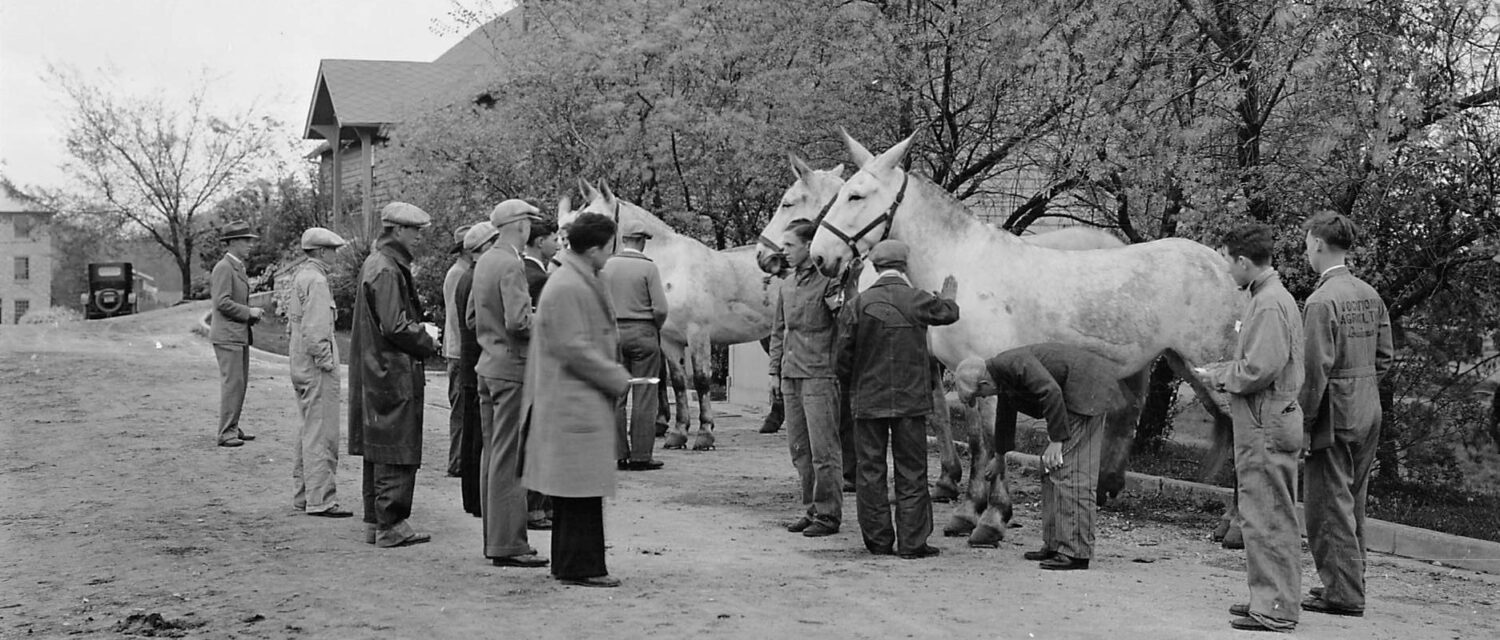
There is an old saying that one picture is worth a thousand words. This week the Friday Footnote arrives in Nevada. In researching agricultural education in Nevada, I ran across the photo below. If you had to guess what the photo and accompanying article was about, what would you say?

Would it help to know this photo was published in 1918 in the Reno Gazette-Journal? My first impression was this was an article about how schools in Nevada had accepted the provisions of the Smith-Hughes Act and were starting to offer classes in vocational agriculture. After Smith-Hughes was signed into law in 1917, states had to accept the provisions of the Act, appropriate matching funds, and have schools apply for funding. So it made sense this photograph was taken in 1918. But my assumption was wrong.
The Two Big Events of 1917
Two major events occurred in 1917. The Vocational Education Act of 1917, commonly known as the Smith-Hughes Act was enacted AND the United States entered World War I. World War I had a devastating impact on agriculture in Europe.
World War I severely impacted European agriculture by causing massive labor shortages, disrupting supply chains, and reducing output by over 50% in nations like France and Italy. The war triggered widespread food shortages across Europe.
To help alleviate the food shortages in Europe and to help feed the American and allied troops in the War, a number of food production measures were implemented in the United States.
One U.S. activity was to create the Boys’ Working Reserve. The image above was to encourage young men between the ages of 16 and 21 to volunteer and enroll in the Boys’ Working Reserve.
In the article accompanying the photograph we learn that a nationwide drive was to be held starting March 14, 1918 to enroll boys in the Working Reserve. The boys were needed to engage in agricultural, industrial and vocational work. The article states (Reno Gazette-Journal, March 12, 1918, p. 6):
There are over 5,000,000 boys sixteen to twenty-one in the United States. Of these 2,000,000 usually are idle during the summer school vacation. Many others are employed part time or in non-essential occupations.
The government’s hope is to get every healthy boy working at an essential occupation this summer. It considers farming, truck gardening, stock tending, and fruit harvesting the most essential things boys can do this summer.
Boys are not asked to quit school and will not be accepted before vacation begins unless the teacher or principal agrees.
Each boy must have written consents of his parents or guardians.
View the entire article (Figure 6) at the end of this Footnote.
A letter signed by the Governor of Nevada, the State Superintendent of Schools and the President of the University of Nevada was sent to all high school principals explaining the program and asking for their cooperation in enrolling boys in the Working Reserves (See Figure 2).
 Figure 2. From The Daily Appeal of Carson City, Nevada, June 20, 1918.
Training in Agriculture is Needed
To prepare the boys for summer work in agriculture an intensive month long training course was offered at the University of Nevada. The details are as follows (Reno Gazette-Journal, March 12, 1918, p. 6):
An intensive training course in agriculture will be given at the university from April 1 to July 1. Each boy who wishes can take this course for a month and he will be given full credit for his school work as well as learning considerable about agriculture gas engines and tractor operations. Fifty boys will be handled each month at the university and a charge of $25 for room and board will be all the expense that is attached to the course.
During the first month of the agricultural short course at the University of Nevada seventy-six boys were enrolled representing twelve different high schools. (Elko Independent, April 5, 1918, p. 3). The schools and the number of students enrolled were Reno (37), Sparks (7), Lovelock (7), Winnemucca (6), Fallon (4), Carson City (4), Goldfield (3), Yerington (3), Manhattan (3), Silver City (1), Minden (1) and Stillwater (1)
It did not take the boys who completed their training at the University of Nevada long to start work. In May of 1918 24 of the boys were working on the Union Land and Cattle Company near Topaz, Nevada. See Figure 3.
 Figure 3. Reno Gazette-Journal, May 2, 1918, page 8.
Concluding Remarks
Within a week of the initial enrollment period of March 14, 1918 in Nevada, 220 boys had signed up for the Boys’ Working Reserve. But the Boys’ Working Reserve was not just a Nevada thing, it was nationwide. To learn more about the uniform, insignia and other aspects of the Boys’ Working Reserve please refer to the March 22, 2019 Friday Footnote – Down on the Farm.
 Figure 4. A Recruitment Sign for the Boys’ Working Reserve.
During the University of Nevada short course, the boys learned about tractor driving. I wonder if they learned about the various modifications and attachments that could be used with Ford automobiles that turned them into tractors. There were a number of kits available during World War 1. One is pictured below. Next week we will learn about some of the Ford car tractor modification kits used in Nevada.
 Figure 5. One example of a Ford Tractor Attachment kit.
 Figure 6. Reno Gazette-Journal, March 12, 1918, p. 6