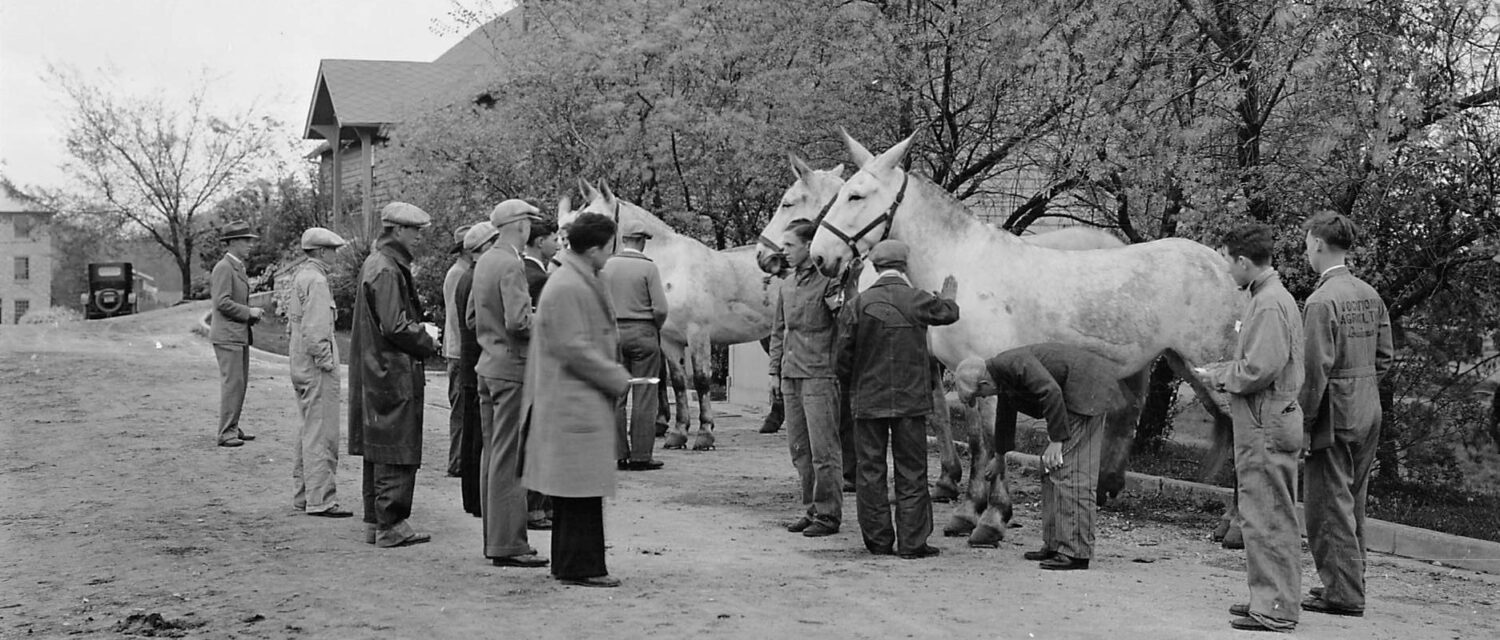
In last week’s Footnote we learned that many Nevada boys volunteered to serve in the U.S. Boys’ Working Reserve to help farmers during World War I. These boys attended a month long training course in agriculture at the University of Nevada and then went out to work on farms. Multiple sources indicate the boys learned to drive tractors during their training. I found this fact to be interesting.
Why was it interesting? During the World War I era over 90% of the farmers and ranchers in Nevada were still using teams of horses for their agricultural work. Due to topography and the nature of farming in Nevada, horses and mules were often preferred over early tractors, which were slow and could not maneuver as easily in rocky or steep terrain. It should be remembered that early tractors were often steam powered and were huge.
I wonder if the boys in the training course at the University of Nevada learned how to farm with horses and mules. I also wonder if the boys learned how to convert the Ford automobile into a tractor. Numerous automobile to tractor conversion kits were sold at this time for the Fords (75% of the automobiles during this era were Fords). In this Footnote we will learn about the various conversion kits.
The Adapto-Tractor Attachment Kit
If you lived near Winnemucca, Nevada you would be able to purchase a conversion kit, known as the Adapto-Tractor kit for use with a Ford automobile (See Figure 1). The price was $240. The advertisement suggested selling your horses and to stop buying expensive horse feed. The amount of money saved by doing this could pay for the Adapto-Tractor kit.
 Figure 1. Advertisement in The Silver State newspaper, Winnemucca, Nevada. May 29, 1919
The kit was made by the Geneva Tractor Company of Geneva, Ohio but was sold across the country. Typically the kit was advertised as the Geneva Adapto-Tractor kit. The kit included an auxiliary cooling attachment to keep the car from overheating while in agricultural use and included large steel wheels. It was claimed that it took 20 minutes to convert your Ford car into a tractor.
One of the methods used to sell the kit was to have demonstrations of the kit in use (See Figure 2)
 Figure 2. A California demonstration of the Adapto-Tractor. From the Los Angeles Evening Express, October 12, 1918.
The following advertisement appeared alongside the photo above.
 Figure 3. An advertisement from the Los Angeles Evening Express, October 12, 1918.
Join the Crowd
The Adapto Tractor kit was not the only tractor conversion kit sold during World War I. About a dozen companies made car-to-tractor conversion kits. In 1917 the various tractor conversion companies formed the National Tractor Attachment Association.
The Catterlouse tractor attachment was manufactured in Spokane, Washington and was found primarily in the western states. It was somewhat unique in design. The rear tires of the Ford were removed and replaced by treads like an army tank. The advertisements state the attachment was designed specifically for the soils of the Northwest United States and only five bolts were involved in the conversion. See Figures 4 & 5.
 Figure 4. From the Cascade (MT) Courier, December 20, 1918.
 Figure 5. From The Spokesman-Review, Spokane, Washington, May 27, 1917.
The Me-Go, (or Megow) convertible tractor was manufactured by the Convertible Tractor Company of St. Paul, Minnesota. The owner of the company was Charles F. Megow. One unique characteristic of this kit was one back wheel pushed while the other pulled. The kit sold for $325. See Figure 6.
 Figure 6. Right image from The Nonpartisan Leader, Fargo, ND, May 26, 1919. Left Image from the Red Square website.
The Farm Tractor Company of Fond du Lac, Wisconsin sold a conversion kit they called the 20th Century Farm Horse. It basically had steel back wheels like several of the other conversion kits. The advertisements listed 6 reasons why farmers should purchase the 20th Century Farm Horse:
- Tractors are cheaper and more efficient than horses.
- Fords are cheap and are recognized as the Universal car.
- 20th century Farm Horse attachment is cheap and durable and converts a Ford into a Powerful Tractor.
- Not only is the original cost small but the cost of running one is way less than horse feed. They don’t eat when not in use. They don’t get tired. Flies don’t bother them. In hot harvest weather, they don’t drop in the harness.
- In the rush season plowing can be done at night by means of Ford headlights.
- When plowing season is over, two hours work and you have a Ford pleasure car.
 Figure 7. From The Idaho Statesmen, June 17, 1917.
The Can-A-Ford tractor attachment company used a play on words in marketing their attachment. They said there were two types of tractor attachments—the Can-A-Ford and those you cannot afford. See Figure 8.
 Figure 8. From the Wichita (KS) Eagle, June 12, 1918.
Some of the other companies selling tractor conversion kits for Ford automobiles included:
- Staude Mak-a-Tractor of St. Paul, Minnesota
- Smith Form-a-Tractor of Chicago, Illinois (at times spelled Smith Farm-a-Tractor. They also sold the Smith Form-a-Truck)
- Curtis Form-a-Tractor of Chicago, Illinois
- Knickerbocker Forma Tractor of New York
- Pullford Company of Quincy, Illinois (sometimes spelled Pulford)
- 3-P Tractor Company of Davenport, Iowa (the 3 P’s were Plowing Pulling Power)
- Unitractor Company of Chicago, Illinois
- Rapid Tach-A Tractor of Des Moines, Iowa
- Shaw Manufacturing Company of Galesburg, Kansas. They called their conversion kit the “Trail Blazer” and its ads encouraged people to tractorize their Model T Ford.
Montgomery Ward and Sears Roebuck also sold conversion kits. The Sears conversion kit was built by the Peru, Illinois Plow Works and sold for $92.50. It was named the Sears Thrifty Farmer.
Concluding Remarks
Most of these companies did not survive and lasted only for a few years. While the idea sounded good, if you needed to run to town in your car, you had to dismantle the tractor attachment. Some ads said this could be done in 15 minutes while others said two hours. And the steel wheels would tear up the road if you decided to drive it to town without changing the wheels.
Smaller more maneuverable tractors appeared on the scene during this era. The Fordson Model F appeared in 1917 and the Farmall appeared in 1923. While the convertible kits cost less, buying a real tractor was more practical in the long run.
Times do change and we must be willing to adapt to change.
Teaching Suggestion
Divide your students into small groups and assign each group one of the conversion kits to research. Have each group prepare a sales presentation about that conversion kit and present it to the class.