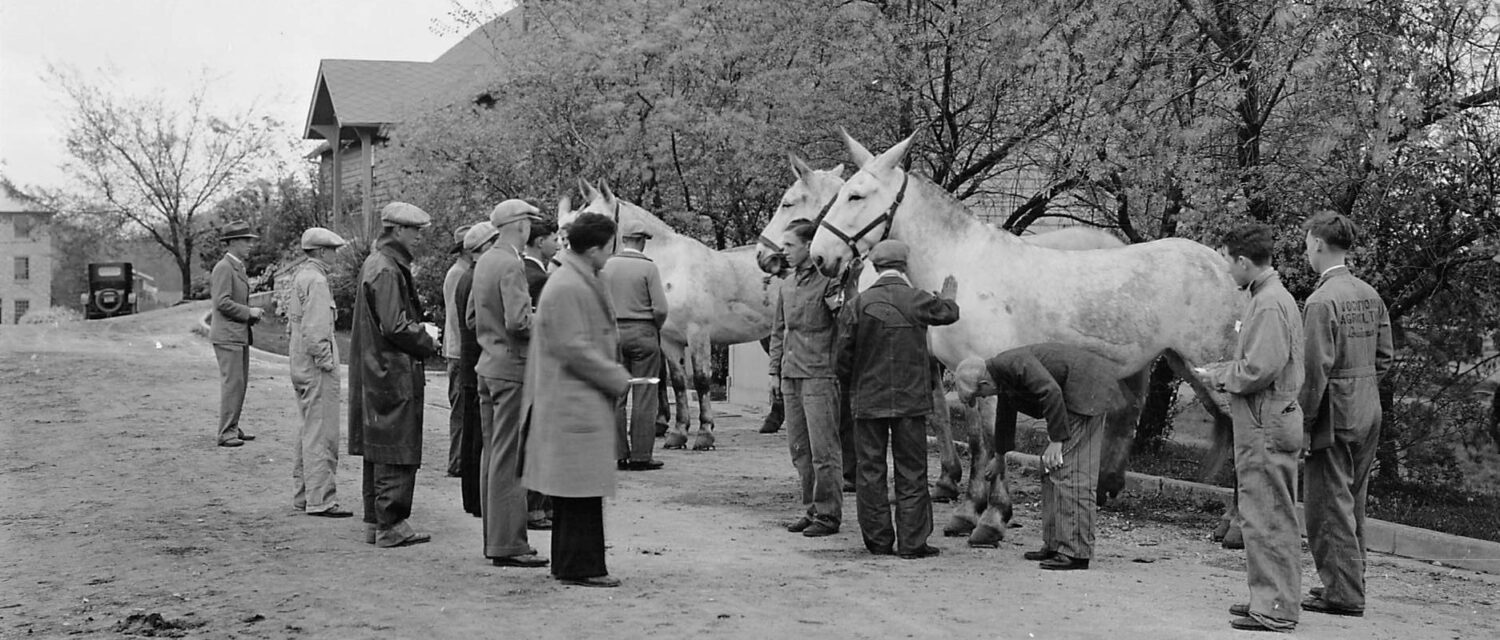
This week the Friday Footnote arrives in New Hampshire. The history of education in New Hampshire goes way back. In the early 1800s academies were established in many New Hampshire villages. These academies were tuition based and/or had wealthy benefactors. The academies promoted liberal arts and classical studies. Graduates went on to become lawyers, doctors, clergymen and the like.
By the 1850s public high schools began to replace academies. However many academies survived by contracting with towns to serve as their public high school. That model still exists today in some localities. However the curriculum had not changed – it still focused on liberal arts and classical studies.
In the early 1900s the leading educators in the state saw a need for a different approach to education. Henry C. Morrison, the state superintendent of public instruction, in a report to the Governor of New Hampshire in 1907-1908 stated (Stimson & Lathrop, 1942, p. 286):
… the fundamental necessity is that we so modify our existing educational scheme that it will select the strongest of each generation as much for agriculture and for the industries as for the professions.
… the unspoken message of our school must be “Manual work is as desirable as brain work, provided you can learn to make brain and hands work together.”
A country high school or academy having at least one curriculum devoted to agriculture will begin to turn the drift of the able and the progressive of each generation back toward the farm instead of toward the city.
Morrison’s admonition was backed up with action. In 1907 he prepared four suggested secondary school curricula – college preparatory, domestic arts, manual arts, and agriculture. He described the agriculture focused curriculum as “leading toward a farm life, or toward further agricultural study.”
Morrison stated some land would be needed for demonstration purposes and some greenhouse construction would be needed at schools where agriculture was taught. He further stated that the cost of the agricultural program ought to be met by sales of the products from the farming program. This would be desirable because it would send a message to the students that farming pays.
The Early Adopters
Prior to Morrison’s report several secondary schools in the state had offered courses in agriculture.
- Coe’s Academy in Northwood first offered agriculture classes in 1905. (Spoiler Alert – in two weeks we will learn they are still teaching agriculture today)
- Gilmanton Academy was approved to offer agricultural courses in 1906. The goal was to prepare students to enter the State Agricultural College.
- Lebanon High School had approval to teach agriculture in 1906.
At the beginning of the school year in 1908 -1909 Pinkerton Academy and Walpole High School started teaching agriculture. Within the next two years several additional schools started teaching agriculture:
- Colebrook Academy
- Proctor Academy
- Hopkinton High School
- Jefferson High School
- Alton High School
- Whitefield High School
It should be noted that Colebrook Academy started as a private institution but was later converted to a public tax supported high school but retained the name of Colebrook Academy. The fact that Colebrook Academy was teaching agriculture prompted the United State Bureau of Education to publish a bulletin titled The Readjustment of a Rural High School to the Needs of the Community in 1912. The bulletin describes how manual arts, domestic arts, and agriculture were added to Colebrook Academy which traditionally had only a college preparatory curriculum. See Figure 1.
 Figure 1. The cover of the 1912 Bureau of Education bulletin and two of the illustrations from the bulletin.
In the introductory section of the bulletin it is stated (Brown, 1912, p. 11)
The introduction of agriculture and domestic arts into the program as regular studies is to overcome a prevalent tendency to think of agriculture and home making as unworthy callings. On the contrary, these arts should be exalted to an honorable place in the estimation of the youth of the land. Agriculture must be raised to a position of as great dignity as law, medicine, or engineering. Home making must be looked upon as a profession by the girls who go out from our secondary schools. Never will these schools be truly efficient in the highest degree until these great arts upon which the future welfare of State and Nation depend are given their proper place side by side with the older traditional subjects.
The bulletin provides great detail about the readjustment of the school by describing the curriculum and facilities along with illustrations. Near the end of the bulletin it is stated (Brown, 1912, p. 26):
When the boy finishes the high-school course, if he is not one of the few who can go to college, he finds himself equipped with an interest in the problems of the farm, with an appreciation of the value of farm life, with a conception of the dignity of scientific agriculture as a profession, and with an attitude toward farm life which is entirely different from that of those who have been for four years educated away from the farm and the home and who have been taught that only with the brain can a living honorably be made. When farming is raised to the dignity of a profession, by the introduction of scientific methods, the trend of population toward the city will in some measure cease.
In 1913 three deputy superintendents of public instruction were appointed in New Hampshire with one being over practical arts education. George Whitcher was appointed to this position and is considered the first state supervisor of agricultural education even though that was not his title. In 1920 Waldo Cunningham was officially appointed as the state supervisor of agricultural education and was also assigned teacher training duties at the New Hampshire College of Agriculture and Mechanical Arts.
By 1914 24 academies and high schools in New Hampshire were teaching agriculture.
 Figure 2. Article from The Portsmouth Herald, March 20, 1913
When the Smith-Hughes Act was passed in 1917, New Hampshire was well positioned to accept the provisions of the Act. Seventeen schools received Smith-Hughes funding for teacher salaries. The outbreak of World War I created a teacher shortage as many agriculture teachers enlisted.
After the war, agricultural education resumed but the growth was spotty. The number of schools offering agricultural education fluctuated between 10 and 17.
The Granite State Association of the Future Farmers of America
Agricultural clubs organized by the Extension Service were found in schools in New Hampshire in the early years. A 1926 Memorandum of Understanding called for cooperation between the agriculture teachers and the extension service. The agricultural clubs in the schools were primarily social in nature.
After the establishment of the National FFA in 1928 the agricultural education leaders in the state started exploring the idea of joining the FFA. It took a while but finally in 1931 a national charter was applied for and awarded to the Granite State Association of the Future Farmers of America. New Hampshire was the 46th state to receive a national charter. The charter application can be viewed at https://archives.indianapolis.iu.edu/bitstreams/a7c207d2-27b6-4d05-bbed-ee1700462f97/download.
The first mention of the Future Farmers of America in a New Hampshire newspaper was in 1936. The article was about a public speaking contestant. When Elmer Johnson of Winchester was selected as a national FFA Officer in 1938 that news made several newspapers.
 Figure 3. From The Portsmouth Herald, October 27, 1938.
While it might not have made news outside of New Hampshire, Susan Pratt of Winchester was elected as the state FFA secretary in 1966; three years before the national FFA allowed females to be in the FFA.
Concluding Remarks
The Great Awakening refers to a series of intense religious revivals that swept the American colonies during the 1730s and 1740s. That term could also apply to education during the 1900s and 1910s. Education in America was experiencing a Great Awakening by realizing the need for and importance of vocational education. Just as New Hampshire was experiencing the Educational Great Awakening during this era, so were numerous other states. As we approach the 100th anniversary of the FFA, we need to document the impact in our communities and states made by the FFA and Agricultural Education.
References
Brown, H. A. (1912) The Readjustment of a Rural High School to the Needs of the Community. United States Bureau of Education, Bulletin 1912, No. 20.
Stimson, R. & Lathrop, F. (1942). History of Agricultural Education of Less Than College Grade in the United States. Vocational Division Bulletin No. 217. Federal Security Agency. U. S. Government Printing Office.