This week, October 21-24, 2026, the 99th National FFA Convention was conducted. However, this was not really the 99th national gathering of vocational agriculture students. It was actually the 101st national meeting of vocational agriculture students.
Prior to the establishment of the National Future Farmers of America, vocational agriculture students were meeting for what was known as the National Congress of Vocational Agriculture Students in Kansas City, Missouri starting in 1926.
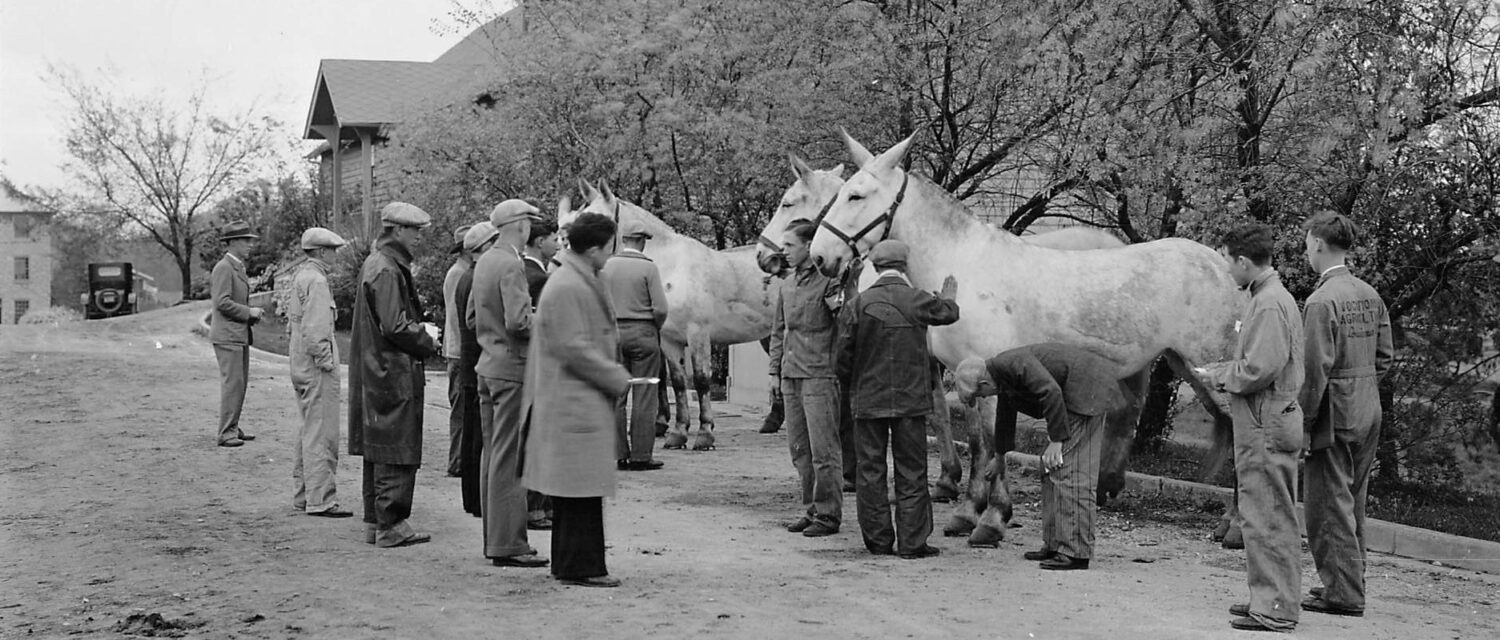
At the first Congress in Kansas City in 1926 1,545 vocational agriculture students (including some 4-H members) from 22 states attended. While livestock judging was the principal activity of the Congress the students also attended the American Royal Livestock Show and engaged in educational tours.
In this Friday Footnote we will learn about the National Congress of Vocational Agriculture Students. This event was the forerunner leading up to the establishment of the national Future Farmers of America. The National Congress of Vocational Agriculture Students occupies an important but frequently overlooked place in the history of agricultural education.
The Smith-Hughes Roots
When Congress passed the Smith-Hughes Act in 1917 a Federal Board for Vocational Education was established. The Board was responsible for implementing the Smith-Hughes Act and for providing leadership for the future direction and growth of vocational education, including vocational agriculture (Stimson and Lathrop, 1942).
One of the first actions of the Federal Board was to employ a staff of individuals in agricultural education, commercial education, home economics education and industrial education to provide national direction for these four vocational disciplines.
Seven leading agricultural educators from across the country were hired as employees of the Agricultural Education Service of the Federal Board. These individuals were stationed in their geographical regions but were moved to Washington, DC in 1920 and the five original regions were reduced to four regions.
These federal supervisors visited the various states in their region actively promoting vocational agricultural, educating state leaders about the Smith-Hughes Act and conducting regional conferences where states could share their activities and accomplishments.
One of the activities reported at regional conferences were contests for vocational agriculture students in various states. In the 1926 Report of The Federal Board for Vocational Education to Congress, it took three pages to summarize the various judging contests being conducted for vocational agriculture students in states and on a regional basis. The report concluded that nearly every state had some type of annual judging contest. (Federal Board for Vocational Education, 1926)
Such competitions developed gradually from local events into statewide activities. Historical records document state-level judging contests for vocational agriculture students in Virginia and Alabama by 1919 and in North Carolina, Nebraska, and New Mexico by 1920. In some of the western states these judging contests were being conducted as part of regional livestock shows such as Portland’s Pacific International (35 teams) and the Rocky Mountain Livestock Show and the Denver Livestock Show (Tummons, Simonson, Martin, 2017).
These competitions served several educational purposes. They reinforced classroom instruction, introduced students to agricultural standards, encouraged pride in achievement, and created opportunities for students to interact with agricultural professionals.
Most importantly, judging contests provided a practical reason to bring vocational agriculture students together in large numbers. Perhaps it was time for a national event.
The Move to a National Judging Contest
At the 1924 annual meeting of the National Society for Vocational Education (now the Association for Career and Technical Education – ACTE), the agricultural education section appointed a committee to investigate the possibility of establishing a national dairy judging contest for vocational agriculture students.
The committee subsequently negotiated with officials of the National Dairy Show, scheduled for Indianapolis, Indiana, in October 1925 to host a national dairy judging contest. The resulting competition brought together 17 vocational agriculture teams. The team from Keytesville, Missouri won the contest.
 Figure 1. The Indianapolis Star, October 14, 1925.
Although modest in scale, the event demonstrated that a national student competition could be organized successfully and that vocational agriculture students would travel considerable distances to participate. The 1925 dairy judging contest became a significant precedent for the National Congress.
Because of the success of the judging contest at the National Dairy Show, Dr, C. H. Lane, chief of the Agricultural Education Section of the Federal Board for Vocational Education approached the International Livestock Exposition in Chicago with a proposal for a national livestock judging contest for vocational agriculture students. The Exposition Board voted against the proposal.
Not to be deterred, Dr. Lane then traveled to Kansas City and met with officials from the American Royal Livestock Show, the KC Chamber of Commerce, the Kansas City Star newspaper, and breed associations to propose a national livestock judging contest for vocational agriculture students. All parties agreed to having a national livestock judging contest and to also support having a National Congress of Vocational Agriculture Students.
The First National Congress of Vocational Agriculture Students
In November 15-17, 1926 the Congress was held but it was more than a judging contest. The team from Oklahoma won the livestock judging contest and a boy from New Mexico was the high individual. A banquet for the students was held with Will Rogers being the speaker. In addition to judging the students visited the Armour Packing Plant, toured the Federal Reserve and went to the theater.
 Figure 2. A newspaper account of the first National Congress for Vocational Agriculture Students, The Bunceton (MO) Eagle, December 17, 1926.
The Congress helped students see the relationship between their vocational agriculture instruction and the larger agricultural economy.
For many young people from rural communities, attendance also offered a rare opportunity to visit a major city, meet students from other states, and observe large-scale agricultural businesses.
These experiences helped establish a pattern that would become central to future FFA conventions: combining educational competitions with leadership development, industry exposure, and fellowship.
The Second National Congress of Vocational Agriculture Students
Since the first Congress was such a success a second National Congress was held in 1927 back in Kansas City in conjunction with the American Royal. Attendance increased to approximately 2,000 students from 27 states. Livestock judging and meat identification were major activities.
A report of the various activities at the 1927 Congress was featured in the Lawrence (KS) High School Budget. To learn what the students thought was interesting about the Congress read the bonus content at the end of this Foornote.
 Figure 3. Lawrence High School Budget, November 18, 1927.
An important development in 1927 was the adoption of a constitution and bylaws for the National Congress.
These documents addressed the administration of the judging competitions, including contestant eligibility, judging procedures, contest officials, and other organizational requirements.
The constitution was prepared by a committee chaired by C. H. Lane and including Ray Fife of Ohio, Guy E. James of Missouri, William Kerr of Idaho, and E. B. Nelms of Oklahoma.
The document was issued through the Federal Board for Vocational Education.
This was a significant development because it formalized the operation of the Congress and provided a more stable administrative structure for future events.
By 1927, interest in creating a national vocational agriculture student organization was increasing. Henry Groseclose surveyed agricultural education leaders and found that 12 states had statewide young farmer organizations, while 15 additional states had local organizations.
However no unified national association existed. At the third National Congress in 1928 the National FFA was established. More about that in a future Footnote.
After 1928
It is interesting to note that after the founding of the FFA in 1928 the annual National Congress of Vocational Agriculture Students continued. Even after the FFA was officially established the annual national FFA conventions were still identified as the National Congress of Vocational Agriculture Students. See the 1929 American Royal Pin in Figure 4.
 Figure 4. Image from David Laatsch.
The September 1935 AVA Journal and News Bulletin contained the following (p. 58):
 Figure 5. September 1935 AVA Journal and News Bulletin
Concluding Remarks
The Founding of the national FFA did not happen by spontaneous combustion. Many entities and individuals contributed to the creation of the FFA. The National Congress of Vocational Agriculture Students contributed to the establishment of the FFA in several important ways.
First, it provided an established national meeting place. Without the Congress, organizing a gathering of student delegates from numerous states would have required creating an entirely new event.
Second, the Congress demonstrated that vocational agriculture students were willing and able to participate in national activities.
Third, it brought together the agricultural educators, federal officials, and state leaders necessary to develop a national student organization.
Fourth, it had already established relationships with the agricultural industry, providing an important foundation for future sponsorships and educational programs.
Finally, the Congress helped create a sense of national identity among vocational agriculture students.
The FFA was therefore not simply an organization that happened to be founded during the Congress. It was, in significant respects, an outgrowth of the Congress’s educational and organizational activities.
The distinction is important: the Congress brought students together for an annual educational event, while the FFA established a permanent organization with officers, membership, and a national constitution.
Next week we will look at the third national congress and how the FFA was established during this congress.
References
Federal Board for Vocational Education. (1926). Tenth annual report to Congress of the Federal Board for Vocational Education. U.S. Government Printing Office.
Federal Board for Vocational Education. (1927). Constitution and bylaws of the National Congress of Vocational Agriculture Students (Miscellaneous publication).
Moore, G. E. (2025, October 24). The birthplace of the FFA—Missouri. The Friday Footnote, North Carolina State University. Read article.
National FFA Organization. (n.d.). FFA history. https://www.ffa.org/ffa-history/
Stimson, R. W., & Lathrop, F. W. (1942). History of agricultural education of less than college grade in the United States. U.S. Government Printing Office.
Tenney, A. W. (1978). The FFA at 50. National FFA Center.
Tummons, J. D., Simonsen, J. C., & Martin, M. J. (2017). Role of the agricultural industry and judging events in formation of the Future Farmers of America. Journal of Agricultural Education, 58(1), 236–250. https://doi.org/10.5032/jae.2017.01236
Bonus Content
Mr. Campbell, the ag teacher at Carrollton High School in Missouri, asked his students to write a paper titled “The most interesting thing that I saw at the American Royal.” This is what the students wrote as published in The Carrollton Democrat on November 25, 1927.
